
Free Download How China Became Capitalist
When obtaining How China Became Capitalist as your analysis resource, you could get the easy method to evoke or get it. It requires for you to pick and download and install the soft file of this referred publication from the link that we have supplied right here. When everybody has really that fantastic sensation to read this publication, she or the will always believe that reading publication will constantly assist them to get far better destination. Wherever the location is forever much better, this is what most likely you will certainly obtain when picking this book as one of your analysis sources in spending downtimes.
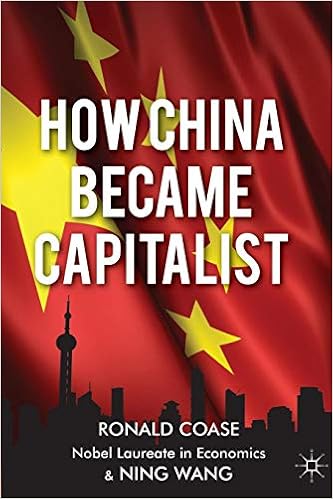
How China Became Capitalist

Free Download How China Became Capitalist
Welcome once more, we always invite the reader to be in this website. Are you the beginner to be reader? Never mind. This website is in fact readily available and also appropriate for everybody, In addition, the individual that truly needs motivations and also resources. By this condition, we always make updates to obtain whatever brand-new. The books that we collect and provide in the lists are originating from numerous resources inside and also outside of this country. So, never ever be question!
When having leisure time, just what should you do? Just sleeping or sitting at home? Full your leisure time by analysis. Begin with currently, you time have to be precious. One to extend that can be checking out material; this is it How China Became Capitalist This publication is supplied not only for being the material reading. You recognize, from seeing the title and also the name of author, you have to know exactly how the quality of this publication. Also the author as well as title are not the one that decides guide excels or not, you could contrast t with the experience as well as knowledge that the writer has.
This publication will certainly be constantly most desired because the topic to climb is preferred. Besides, it has the subject for every single age and condition. All levels of people rate quite possibly to read this book. The development of this publication is that you may not need to feel difficult to comprehend exactly what this book offer. The lesson, understanding, experience, as well as all points that could provide will certainly need your life time to feel far better.
Many people could have different need to check out some books. For this book is likewise being that so. You may discover that your factors are various with others. Some might read this book for their deadline obligations. Some will certainly read it to improve the expertise. So, what sort of reason of you to read this impressive How China Became Capitalist It will rely on how you look as well as consider it. Just get this publication now and also be among the amazing readers of this book.
Review
"Patient readers will be rewarded with a better and deeper understanding of the most extraordinary transformation in modern economic history." - The Wall Street Journal "As China is sure to become a hotly debated focal point in the presidential election, this book, with its emphasis on markets and history, becomes of paramount importance." - The Washington Times "Anyone curious as to how China became the world's second biggest economy should read this interesting book." - The LSE Review of Books "This is a major contribution to the whole literature on economic change as well as on China. Nowhere in all of the literature on economic change and development that I know is there such a detailed study of the fumbling efforts of a society to evolve and particularly one that had as long and as far to go as China did." - Douglass C. North, 1993 Nobel laureate in Economics "Ronald Coase, now 100 years plus, and Ning Wang have written a compelling and exhaustive commentary about China's fitful transition from Socialism under Mao to today's distinctive capitalist economy. No student of China or socialism can afford to miss this volume." - Richard Epstein, University of Chicago Law School "This book is one of the greatest works in economics and in studies of China, not only for today, but for the future." - Chenggang Xu, University of Hong Kong "Coase finds a nation whose philosophy and policy have reflected the same simple principle - 'seeking truth from facts' - that has inspired his own path-breaking analyses of firms, markets and law. A fascinating and exceptionally thought-provoking account of how China, repeatedly seeking more efficient socialism, found itself turning capitalist." - Stephen Littlechild, Emeritus Professor, University of Birmingham, and Fellow, Judge Business School, University of Cambridge
Read more
About the Author
Ronald Coase is Nobel Laureate in Economics. His work has had a profound impact on modern economics; it clarified the theory of the firm and gave rise to the field of Law and Economics. Professor Coase is currently Clifton R. Musser Professor Emeritus of Economics at the University of Chicago Law School, and he is also a research advisor at the the Ronald Coase Institute, USA and founder of the Ronald Coase Center for the Study of the Economy at Zhejiang University. Ning Wang is Assistant Professor at the School of Politics and Global Studies, Arizona State University, USA.
Read more
Product details
Paperback: 272 pages
Publisher: Palgrave Macmillan; 2012 edition (March 20, 2012)
Language: English
ISBN-10: 1137351438
ISBN-13: 978-1137351432
Product Dimensions:
6 x 0.6 x 9 inches
Shipping Weight: 14.9 ounces (View shipping rates and policies)
Average Customer Review:
3.9 out of 5 stars
22 customer reviews
Amazon Best Sellers Rank:
#263,115 in Books (See Top 100 in Books)
A clearly written, penetrating analysis of the transformation of China as both a "top down" and "bottom up" phenomenon. The authors analyse the transformation of China as a series of discovery processes, making some acute observations about the interaction between politics, ideology, history and institutions. Ronald Coase (1991 Nobel memorial Laureate in Economics), who was over a 100 when the book was published, was one of the most intellectually influential economists of the C20th. (Go through his fellow winners of the Nobel memorial Prize in Economics, tick off those whose seminal work was based on Coase's development of the concept of transaction costs; now find any other economist who started publishing in the C20th whose work has led to that many Nobel memorials. Then consider that his work has also been influential outside economics.)The pragmatism and political cunning of Deng is a key part of the story, but the authors also connect that pragmatism to continuing tendencies in Chinese history and thought. One of the striking observations is that the disagreements between Deng and Chun Yen opened up policy possibilities because there was no settled "line", just an agreed pragmatism. But the authors also examine how much of the story was of people at the margins taking opportunities presented to them also fed into the processes of institutional change.This book is essential reading if you want to understand why and how China changed so profoundly.
Few scholars have changed the face of economics like Ronald Coase. His work brought a very rare commodity to the economics profession - clarity. His observations, based on empirical evidence and "old-fashioned" fact-finding, have unearthed a body of work that has transformed the way we think about simple, but crucial, facts. The ways individuals and firms organize and his work on property rights had a profound impact on how we comprehend issues from the inner working of organizations to the use of market tools to address environmental problems. On the latter, his work provide the academic underpinning for the establishment of the Acid Rain program in the United States in the early 1990s, which was so successful that it virtually wiped out the problem of acid rain in America.At a 101 and not a man to avoid challenges, he now braces himself on an issue that many in the West are puzzled by -"How China Became Capitalist". Again, he brings clarity to a confused picture. Without embracing dogmas from either left or right, he traces the history of Chinese reforms from the rise of Deng Xiaoping to the present. In Coase and co-author Ning Wang's recounting and interpretation, we learn about the unleashing of China's experiment with capitalism. Rather than a top-down approach as many believe, the Chinese government fostered competition between cities and provinces; allowed for experiments and pilots to take place in certain sectors, industries and regions. China after Mao had a blank slate from which to experiment. Throughout this, Coase's work on property rights was critical to many Chinese policy makers. It is no coincidence that alongside Marx and Friedman, Coase is one of the most revered Western economists in China.Coase is the finest of scholars. The Nobel committee (belatedly) understood his contribution as a thought leader, not just a servant of mathematical tools and creator of theorems. Teaching is much about pointing the obvious that surrounds us. That he has always done masterfully and does it again in "How China Became Capitalist". A must-read from anyone interested in economics, and in a clear analysis of Chinese political economy.
When I first toured China (and Chinese industries and collective farms) in the early eighties, the future was uncertain, but hopes of reformers ran high. The messages were confusing and confused. Were there property rights? When would the next backlash against individual initiative begin? This book by Economics Nobel Prize winner (a man who had acquired one-hundred years of wisdom) and his Chinese associate makes it clear that the path from failing socialism to China's economic and cultural resurgence was anything by rationally planned. On the margin, markets emerged and set people free to prosper. On the margin, experiments like Shenzhen - going from fishing village to super-prosperous magnet for the young and enterprising in a few decades – were permitted to flourish. This combined with a non-ideological pragmatism: what worked in creating economic development was accepted by Beijing Centre. The book is insightful in explaining why China's economic renaissance has produced these astonishing results to date. The authors are also correct to point out that copying the ideas and technologies of the West will not carry China to developed-country status. What is needed now is competition in the market of ideas. Will the powerful party elites permit this? The book could have done with some editing to eliminate repetitions and to meld the contributions of the two authors into a more homogeneous whole. Every now and then it is obvious where the historical detail gives way to fundamental economic teaching by the great Ronald Coase. But these are quibbles. It is a great book and obligatory read if you want to know why and how modern China has emerged, and if you want a dose of solid Austrian economics in action.
How China Became Capitalist PDF
How China Became Capitalist EPub
How China Became Capitalist Doc
How China Became Capitalist iBooks
How China Became Capitalist rtf
How China Became Capitalist Mobipocket
How China Became Capitalist Kindle

Posting Komentar