
Free Ebook The Problem of Punishment
When a new choice becomes a brand-new manufacturer of better living, why should be sorry for of it? Something old have to be altered and also renewed with something brand-new, if the new thing is much better. As the extra task that we will certainly recommend, if you have no suggestion to enjoy your leisure time, reading can help you to kill time wisely. Yeah, passing the times totally can be done by everybody. Yet, be sensibly in spending the time is very rare. So, do you want to be just one of the sensible people?
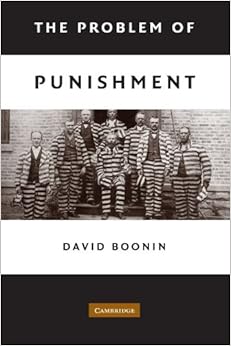
The Problem of Punishment

Free Ebook The Problem of Punishment
Earn currently guide entitled The Problem Of Punishment to be your sources when going to check out. It can be your new collection to not only display in your shelfs but additionally be the one that can help you fining the most effective resources. As in common, publication is the window to obtain on the planet and also you can open the world quickly. These smart words are actually accustomed to you, right?
When some other individuals still feel so hard to locate this book, you could not encounter that trouble. Your means to use the web link and also take part this site is right. You could discover the source of guide as The Problem Of Punishment that will certainly not go out whenever. For making terrific problem, it turns into one of the ways that lead you to constantly make use of and also use the sophisticated innovation.
Guide consists of everything brand-new as well as appealing to read. The selection of topic and also title is really various with other. You can feel this publication as one of the interesting publication since it has some benefits as well as opportunities for changing the life much better. And also now, this publication is offered. The book is positioned with the lesson and details that you need. However, as straightforward book, it will certainly not need much idea to review.
Your perception of this publication The Problem Of Punishment will certainly lead you to get exactly what you exactly need. As one of the impressive publications, this publication will offer the existence of this leaded The Problem Of Punishment to collect. Also it is juts soft file; it can be your collective documents in gadget as well as various other device. The essential is that usage this soft documents book The Problem Of Punishment to check out as well as take the benefits. It is what we indicate as publication The Problem Of Punishment will boost your thoughts and also mind. Then, checking out book will likewise enhance your life high quality much better by taking good action in well balanced.
Review
"... an excellent, thorough account of the concept of punishment. He critically engages in great depth a wide range of theories that purport to explain why the practice of punishment is morally permissible ... In addition, Boonin provocatively calls into question the ultimate need for punishment by insightfully defending an alternative practice of pure restitution from numerous objections. Whether or not one agrees with his defense of abolitionism, Boonin convincingly shows that a plausible solution to the problem of punishment will look very different from any theory that has come before in the literature." - Jim Staihar, University of Chicago Law School
Read more
Book Description
In this book, David Boonin examines the problem of punishment, and particularly the problem of explaining why it is morally permissible for the state to treat those who break the law in ways that would be wrong to treat those who do not. David Boonin argues that there is no satisfactory solution to this problem and that the practice of legal punishment should therefore be abolished.
Read more
See all Editorial Reviews
Product details
Paperback: 310 pages
Publisher: Cambridge University Press; 1 edition (April 14, 2008)
Language: English
ISBN-10: 9780521709613
ISBN-13: 978-0521709613
ASIN: 052170961X
Product Dimensions:
6 x 0.9 x 9 inches
Shipping Weight: 1.2 pounds (View shipping rates and policies)
Average Customer Review:
4.5 out of 5 stars
4 customer reviews
Amazon Best Sellers Rank:
#485,706 in Books (See Top 100 in Books)
I think this book will be required reading for future work in moral philosophy of punishment, jurisprudence and for those general readers interested in the subject. The book is certainly clearly written enough and contains a paucity of jargon such that intelligent and educated general readers will understand it. The book goes through all the justifications so far raised in the philosophical and jurisprudential literature for legal punishment. It is very comprehensive covering tons of consequentialists, retributivist, communicative, educative, implicit consentual/contractual, and alternative theories of punishment.In the end, Boonin argues that all fail to justify their aims and that state sanctioned punishment is always immoral. This is the "abolitionist solution" to the problem of punishment. As any good abolitionist treatise should, Boonin does not stop there; he outlines what institutions may be more rightfully justified to replace punishment (he argues for institutions of victim restitution) and gives some empirical evidence that such a system may work. The author is erudite on both the philosophical, legal and sociological literature on crime and punishment. Even if you do not agree with him that punishment is always immoral, you will appreciate Boonin's clear exposition of the landscape of arguments advocated by proponents on the different sides so far and you will have a road map of where to go from there. I found myself disagreeing with Boonin on his dichotomy between certain forms of restitution and punishment stemming from his definition of (legal) punishment but I can see that he gives at least a plausible argument for his definition.I only wish the book went further outside of state-sanctioned punishment and into the realm of punishment in general to cover things like revenge and the like. Many of Boonin's arguments will have to be seriously modified or new arguments given or maybe some of his conclusions shall be reversed if non state-sanctioned punishment is included.
Since punishment is universally endorsed one wonders why anyone would bother to question the moral justification for it. David Boonin did so fearlessly, rationally, and persuasively in "The Problem of Punishment". In order to advance his thesis that it is morally wrong for the state to punish anyone, he began with a lucid study of the definition of punishment. This alone was a worthy philosophical exercise whether one agrees with his thesis or not. In this regard, he constantly contrasted the concept of punishment with established moral principles. The problem of punishment lies in drawing a line between two groups of citizens (and residents) - offenders and non-offenders. Setting people apart in this way, the state goes about not only harming one group, but intentionally doing so. The issue thus, is how does one find the moral justification to harm a group when it would clearly be morally wrong were it to do the same to the other group.It may be easy to see that the idea of intentionally harming someone is wrong and many would simply shrug off incipient objections by holding that it is a necessary evil. That is a superficial response to the problem and indeed, proves the point Boonin wished to make, that punishment is an evil. The closest philosophical defence to this idea of "necessary evil" is the defence based on consequentialist arguments. Boonin addressed both Act and rule utilitarianism and meticulously built his arguments as to why he thought they were unjustifiable. He addresses some of the major objections to utilitarianism and explained his support for them; one such objection is that the application of utilitarianism insofar as it exempts the wrong if the consequence is that a greater good is achieved. That leads to the justification of punishing innocent people if the punishment of the innocent produces a greater good. He also reminded us of the distinction between "all murderers should be killed" and "all murderers should be killed because they are guilty of murder". It is the latter that must be justified in order to justify capital punishment.Another justification closely analyzed is the principle of retributivism, often recognized by the principal principle of desert as justification. Boonin also discussed other forms of retributivism such as forfeiture based retributivism. This form essentially takes the position that if one kills, then he too may be killed. Boonin says that in the legal context, this is justified only if it is against the law to kill. He argued that if retributivism is a corrrect principle, then the state can punish a person for an immoral act. The problem is, not every immoral act is an illegal act. This destroys the very basis of desert based justification because by that, we are to avoid punishing an innocent person, and that is why we do not punish a person who is legally innocent.Running through the set-up and then the flaws of the major justification for punishment, Boonin then examined other established solutions to the problem of punishment (for example, the solution based on `consent'); and finally, he explored and then dismissed the suggestion of a hybrid solution - when we find ourselves confronted with irremediable flaws in each of the main solutions, the tendency to ask if a combination might be the answer. Boonin explained why that can't be so, and he used the hybrid of consequentialism-retributivism model in illustration.Boonin then summed up the big problem in the simple question, assuming that his arguments against the solutions were right, "What should we do?" It was a rhetorical question given the clear and meticulous arguments he made. Either we continue to punish and hope for the answer to emerge eventually, or we stop punishing people for breaking the law. He found the first morally reprehensible, but he acknowledged that most people would find the latter unacceptable. His provided two alternative answers. First, he theorized the principle of necessity as an excuse rather than a moral justification. This seemed somewhat dubious given his objection to punishment without a moral foundation. Hence this idea was given scarcely a couple of pages. His main alternative theory against punishment was based on an enhanced "victim-restitution" model. Instead of punishing the offender, should concentrate on repairing the harm to the victim of crime. Boonin argued that this is an attractive alternative. Restitution can erase the harm although it cannot erase the wrong. He reminded us that "punishment can no more erase a wrong than restitution." He was prepared to accept punishment as morally justifiable if it could erase the wrong.This was a well thought through and argued book even if we might not agree with the author on every point, we might not likely find an answer to the jurisprudential problem of punishment ourselves. If this book interests you, I would also recommend H L A Hart's "Punishment and Responsibility" (1968), and C L Ten's "Crime, Guilt, and Punishment (1987), the latter, sadly, is out of print.
This is one of David Boonin's more interesting books because the central thesis of the book, that people should not be punished for breaking the law, sounds extremely implausible at first, but once he spells out what his proposed alternative would look like it sounds considerably less implausible. This book is engaging to read, and in particular, the critiques of consequentialist defences of punishment are quite interesting. However, I feel that sometimes Boonin is a little too quick to dismiss a defence of punishment on the grounds that it does not pass the "entailment test", it does not entail that all offenders and only offenders may be punished. I believe he should give more consideration to the possibility that the defence might succeed in defending a view on which a class of people which is almost, but not quite, co-extensive with the class of offenders, may be punished. In general, I had the impression that this was not quite as rigorous as Boonin's other works. But it made for most interesting reading, particularly the final chapter where the theory of "pure restitution" is spelled out. I highly recommend this book as an interesting and compelling defence of a strikingly provocative and counter-intuitive thesis which should give much food for thought.
Certainly worthwhile if you're interested in the book's subject. Very comprehensive, and while not scintillating, also very readable. Somewhat repetitive, but the arguments he makes should contribute a great deal to the debate.
The Problem of Punishment PDF
The Problem of Punishment EPub
The Problem of Punishment Doc
The Problem of Punishment iBooks
The Problem of Punishment rtf
The Problem of Punishment Mobipocket
The Problem of Punishment Kindle

Posting Komentar