
PDF Download
When it requires considerations to select such book to review in referring to the significant trouble that you have now, you need to attempt with this book. , nonetheless, ends up being an extended publication does not suggest that this publication is rarely thoughtfully. You could transform your mind undertaken the best publication will feature the most challenging language and words to comprehend. This situation will certainly certainly make rubbish for some individuals.

PDF Download
If you have been able right here, it means that you have the ability to kind and link to the internet. Once again, It suggests that web turns into one of the service that could make simplicity of your life. One that you can do now in this collection is additionally one part of your effort to enhance the life top quality. Yeah, this website currently offers the as one of materials to review in this current period.
Every word to utter from the writer includes the component of this life. The writer actually shows how the simple words could make best use of exactly how the impression of this book is said directly for the visitors. Even you have found out about the material of so much, you could easily do it for your much better connection. In supplying the presence of the book idea, you can discover the boo website here.
Based on the exactly how this publication will certainly worry about, it is actually mentioned that this publication excels and correct for you. When you have no sufficient time to finish analysis this book asap, you can start to read it from currently. Yeah, also it has to not be in rapid time, you could take opportunity of couple of free time or in your spare times to review. Also gradually, the materials can be attained as well as leant.
Investing the extra time by reviewing could offer such great experience also you are simply seating on your chair in the workplace or in your bed. It will certainly not curse your time. This will lead you to have even more priceless time while taking rest. It is very enjoyable when at the twelve noon, with a cup of coffee or tea and also an e-book in your gadget or computer system display. By delighting in the views around, below you could start reviewing.
Product details
File Size: 7617 KB
Print Length: 674 pages
Page Numbers Source ISBN: 0321341384
Simultaneous Device Usage: Up to 5 simultaneous devices, per publisher limits
Publisher: Addison-Wesley Professional; 1 edition (August 7, 2006)
Publication Date: August 7, 2006
Sold by: Amazon Digital Services LLC
Language: English
ASIN: B004YWAZUA
Text-to-Speech:
Enabled
P.when("jQuery", "a-popover", "ready").execute(function ($, popover) {
var $ttsPopover = $('#ttsPop');
popover.create($ttsPopover, {
"closeButton": "false",
"position": "triggerBottom",
"width": "256",
"popoverLabel": "Text-to-Speech Popover",
"closeButtonLabel": "Text-to-Speech Close Popover",
"content": '
});
});
X-Ray:
Not Enabled
P.when("jQuery", "a-popover", "ready").execute(function ($, popover) {
var $xrayPopover = $('#xrayPop_3DA3B4605BCD11E9A3DBF4DE95DF34F8');
popover.create($xrayPopover, {
"closeButton": "false",
"position": "triggerBottom",
"width": "256",
"popoverLabel": "X-Ray Popover ",
"closeButtonLabel": "X-Ray Close Popover",
"content": '
});
});
Word Wise: Not Enabled
Lending: Not Enabled
Screen Reader:
Supported
P.when("jQuery", "a-popover", "ready").execute(function ($, popover) {
var $screenReaderPopover = $('#screenReaderPopover');
popover.create($screenReaderPopover, {
"position": "triggerBottom",
"width": "500",
"content": '
"popoverLabel": "The text of this e-book can be read by popular screen readers. Descriptive text for images (known as “ALT textâ€) can be read using the Kindle for PC app if the publisher has included it. If this e-book contains other types of non-text content (for example, some charts and math equations), that content will not currently be read by screen readers.",
"closeButtonLabel": "Screen Reader Close Popover"
});
});
Enhanced Typesetting:
Enabled
P.when("jQuery", "a-popover", "ready").execute(function ($, popover) {
var $typesettingPopover = $('#typesettingPopover');
popover.create($typesettingPopover, {
"position": "triggerBottom",
"width": "256",
"content": '
"popoverLabel": "Enhanced Typesetting Popover",
"closeButtonLabel": "Enhanced Typesetting Close Popover"
});
});
Amazon Best Sellers Rank:
#2,537,317 Paid in Kindle Store (See Top 100 Paid in Kindle Store)
This book is dated, covering .NET 2.0 and below. But, it still has very good information and useful code (such as machine translation code to drop in your projects). But, make sure to get updated information such as type-safe referencing of localized resources (which is also more concise). The book is very well written and reviewed and I would recommend this, along with some updated sources (such as MSDN or the MCTS training books).
Nowadays, if you are a programmer, you might be coding an application that will be deployed globally. Very different from 30 years ago, when you would usually have English-only text for your user interface. Of course, then, the UI was often just standard out and standard in.The book shows how the .NET platform lets you handle internationalisation (i18n) in several ways. You can define strings that will appear in your UI. Grouped into several sets, each set usually specific to a language. So given the name of a string, you can write language-specific versions of it. Plus, there is a Resource fallback process, which lets you define a hierarchy of these sets. So you might make the English set the default, say. Useful if you can't find translations into some other language. Plus, you can be more specific than just specifying a language. Within a language, there might be different terms or spellings, depending on the user's location. Hence, the book describes the concept of a locale or culture. The best example is en-US and en-GB, describing American and British versions of English.The other main aspect of the book shows how the various .NET UIs can use these Resources. For example, Internet Explorer has a control pane that lets you define different locales, and the order in which these will be used, to look up Resource values. Of course, IE comes to you pre-programmed. More importantly, the book shows how to program this ability into your own code, written perhaps using Windows Forms.All this should sound familiar to you, if you've already been programming in Java. Which has had these capabilities since 1998 and earlier. To some extent, the book shows how .NET is still playing catch-up. And that it essentially has achieved parity with Java/J2EE in i18n.The book also has a section which might initially seem very exciting, machine translation. Especially if you have had prior experience dealing with programs that do this. MT is a very hard problem that really belongs fully in AI research. Accurate translations often require human input. Alas, as Smith-Ferrier points out, the book reveals no breakthrough by Microsoft. Essentially, Microsoft has a Web Service that takes an input word and returns a translation into some other language. But still very limited. And you certainly can't hand it a sentence and expect a (correct) result. Its usefulness is mostly in cases where you have single words commonly used in programs, like 'file' and 'quit', and you need translations into another language commonly used in programming. On balance, however, the Web Service is better than nothing. Microsoft has taken the obvious step and automated what can easily be automated.
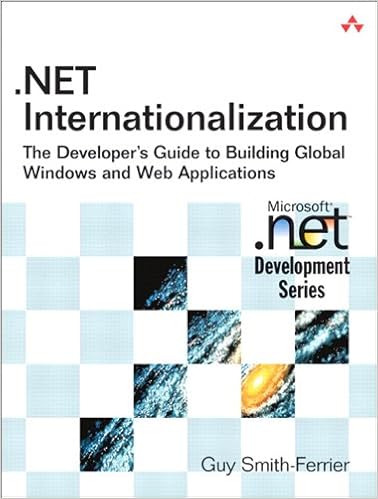
So what's an IBM Lotus Notes/Domino developer looking at a .NET book? Hey, solid fundamentals and learning can come from anywhere! :) And Guy Smith-Ferrier's book .NET Internationalization: The Developer's Guide to Building Global Windows and Web Applications has given me a greater appreciation for what it takes to make a multi-language application that actually works...Contents: A Roadmap for the Internationalization Process; Unicode, Windows, and the .NET Framework; An Introduction to Internationalization; Windows Forms Specifics; ASP.NET Specifics; Globalization; Middle East and East Asian Cultures; Best Practices; Machine Translation; Resource Administration; Custom Cultures; Custom Resource Managers; Testing Internationalization Using FxCop; The Translator; New Internationalization Features in the .NET Framework 2.0 and Visual Studio 2005; Information Resources; IndexMake no mistake... This is primarily a book on how to use Visual Studio 2003/2005 to make your .NET programs functional in more than one language and culture. The information is very detailed in how Microsoft has structured the environment to allow for the use of items such as "resource managers" and "cultures" in development. These features can make it possible to have a single code base but differing text and behavior based on the user's application or browser settings for language. If I were a .NET developer tasked with building an application for use in multiple countries, I'm pretty sure I'd want this book close beside me.But even without being a .NET developer, I still came away with some valuable concepts. Since I *haven't* had to internationalize an application, I pretty much just thought "translate the words and you're done". But it's much more extensive than that. What about languages where the character set is completely different (and not found on your "normal" keyboard?) What about languages that read right-to-left? It was a bit strange to see examples of dialog boxes where input box labels were right justified with the input boxes themselves placed to the left... I mean, it made sense once I thought about it, but I had really never done so. So much for my "open, global" mindset... :)While there are likely better books for someone looking for internationalization concepts on a general basis, this book *does* deliver in that area to a large extent. And if you're focused on .NET, I don't think there would be much question that this would be a prime resource for you...
PDF
EPub
Doc
iBooks
rtf
Mobipocket
Kindle

Posting Komentar