
Download Ebook Real World Color Management (2nd Edition)
Introducing a new hobby for other people may inspire them to join with you. Reading, as one of mutual hobby, is considered as the very easy hobby to do. But, many people are not interested in this hobby. Why? Boring is the reason of why. However, this feel actually can deal with the book and time of you reading. Yeah, one that we will refer to break the boredom in reading is choosing Real World Color Management (2nd Edition) as the reading material.
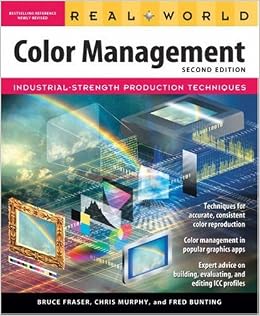
Real World Color Management (2nd Edition)

Download Ebook Real World Color Management (2nd Edition)
Do you need brand-new reference to accompany your leisure when going to residence? Reading a publication can be an excellent selection. It can save your time usefully. Besides, by checking out publication, you could enhance your understanding and experience. It is not just the science or social understanding; numerous points can be obtained after reading a book.
various view. Yeah, this book overcomes a brand-new point that will certainly not just influence, however also enhance lesson and also experience. Having this Real World Color Management (2nd Edition), even as soft file, will certainly show that you have joint to be one of the hundreds viewers on the planet. Yeah, you're one part of the fantastic people that like this book.
Currently, supplying guides for you is type of essential point. It will certainly certainly aid you to discover guide easily. When you truly require the book with the exact same subject, why don't you take Real World Color Management (2nd Edition) now and here? It will certainly not be so challenging. It will be so very easy to see how you intend to discover guide to read. The discussion of individuals that like this publication to check out is much better.
Getting this book in this internet site might not lead you to walk as well as most likely to publication shop. Seeking rack by rack will really spend your time mainly. But, it well not warranties you to be successful finding Real World Color Management (2nd Edition) Therefore, you could locate it in the soft data of this publication. It will certainly provide you the fantastic system of the book suggestion. You could see the web link and also most likely to the web page to make manage. As well as now, your publication look file of this can be your chosen publication as well as area to read this interesting publication.
About the Author
Bruce Fraser is an internationally known authority on digital imaging and color reproduction. In addition to speaking and consulting on these topics, he is the co-author of Real World Color Management, the definitive guide to color management systems, and a contributing editor for Macworld magazine and creativepro.com. Fred Bunting is a writer, illustrator, and speaker on the topics of color theory, color management, and digital imaging, and is the author of the acclaimed Colortron color primer. He is also the co-author of Real World Color Management. Chris Murphy is president of Color Remedies, specializing in worldwide training and consulting in emerging color technologies. He is also the co-author of Real World Color Management.
Read more
Product details
Paperback: 608 pages
Publisher: Peachpit Press; 2 edition (September 18, 2004)
Language: English
ISBN-10: 0321267222
ISBN-13: 978-0321267221
Product Dimensions:
7.4 x 1 x 9 inches
Shipping Weight: 2.6 pounds
Average Customer Review:
4.5 out of 5 stars
75 customer reviews
Amazon Best Sellers Rank:
#406,960 in Books (See Top 100 in Books)
If you're going to spend any time at all on color management then you must get this book. While it doesn't go so far as to explain all of the mathematical formuale used in color physics, it does a great job of explaining all practical aspects of color management in great detail for those who are professional or serious photographers, graphic artists, or pre-press technicians. It's not difficult to understand, but it doesn't insult your intelligence either.Don't waste your time with any of the other "just do X but I won't tell you why" books. Read this one and you'll know what you need to do and why, as well as how everything works.
Fairly good coverage of color management. Could use an update for applications current as of 2018. Needs more info on color management in the pressroom like maybe an entire chapter. Info on Press dot gain calibration for prepress plate machines and density measurement and or using a spectrometer to measure color consistency. Also could use info on CIP4 system usage. Lack of pressroom detail sets it to 4 stars.
It's hard to imagine there's a more thorough take on color management out there. The three who wrote this one are (or were, as Fraser has passed) the most knowledgeable out there on the subject.As the authors wryly joke, even Newton chose not to pursue the science of color in favor of a more rigid, less complicated science like plain old theoretical physics or mathematics! Indeed! Color is complicated, sweetheart! Even so, the authors do about as good a job of conveying all necessary information as any could for the layman and probably other experts as well.There seems to be no one in the business these authors either don't know personally or whose work they don't know extensively. Notable is the fact it's a little surprising three people were able to collaborate so well to write one book in one style that flows very well given the topic. The book is very well organized, which helps a lot too. Clearly, both the writing and the publishing were well thought out by people with serious knowledge of their subject. That's not commonplace anymore.I know I don't need another book on the topic, that all I need to know is packed into this (not light in content nor literally) book. Best I think is how the authors address color management from the standpoint of specific software mostly toward the end of the book after they've laid out principles of color management, including explanation, of course, of the need to manage color in a workflow, assuming one has any interest in arriving at quality results, and extensive discussion of why and how to profile an array of devices. Whether one plans on color rendering "true" to a subject or on departing from "true" color in the interest of creativity. Even more so in the latter case. Reminders of reasons why bother with color management pop up throughout--in text and in sidebars. There's a terrific section on types of workflows, depending on one's objective. Ideally the book is for any running a commercial shop, but then for that reason too very useful for those of us working solo using what equipment we can afford.Speaking of equipment, some that is recommended is priced out of sight for many solo workers. But the authors address problems that way by suggesting alternative ways to do things. For example, printer profiling: which can be most difficult, and costly depending on equipment to be employed. The job is easier the more funds one has to expend on the best equipment, but one can do the job with lesser equipment and with some time to spare. Otherwise, as is suggested, a lot of people might do better to have profiles made by third parties at fairly reasonable prices considering time and energy and understanding required.Not to say one ought simply skip over what's not so easy to understand or what can't be done pending expensive equipment, let alone attempted. It's well worth one's time to try and understand the process even if one doesn't plan to measure a thousand or more little squares of color one at a time. I didn't get everything, especially concerning adjusting tables in software made for the purpose or in Excel on one's own, but I did get the general idea, whether or not I ever attempt to adjust profiles by inputting numbers to a LUT. I likely never will if I can have it done for, say, $50-$100. But who knows, maybe one day should I gain a better understanding and brush up on math I forgot decades ago?Sorry, the book doesn't actually teem with mathematics, so not to worry. It is addressed both to professionals running shops and to solo artists.Input-device profiling struck me as a little easier to do, though a scanner can be tricky and a camera just about impossible to profile. But one might never need to profile either one, depending on the editing software one has and assuming one is very proficient in use of software. Photoshop is recommended though not essential to color managing a workflow.Monitors simply MUST be profiled if one is to get anywhere at all in color-managing workflow such that what is seen on screen comes close to what appears in print. Fortunately, monitors are the easiest devices to profile and even fun to profile using not-too-pricey equipment that can be purchased here at Amazon. If you've not done it you'll be amazed at the difference--before and after. After doing it you'll be able to see just how green was your screen before, or how red, now that your display is displaying a truly neutral gray. All of a sudden color will look "true," much more like what you saw or intended and also thereby far more easily adjusted, or not adjusted at all if you prefer to print directly from camera to printer through your computer. The more direct the more essential to accurately profile devices both input and output, assuming your objective isn't simply a snapshot, although even then when prints (or displays) are sorely lacking, which all prints and displays will be when devices aren't attuned. Even a camera display needs to be white balanced, preferably before shooting.The book teems with illustrations and photos, not least of which are pictures of actual menus from various image-editing programs. Those are VERY helpful, both in getting it right and in gaining a better understanding of the process both specific to the program at hand and more generally. (This could also be a book on how to use color management tools available in the better imaging software out there.)But the book begins with an elaboration on the nature or science of color, including how we humans perceive it and then seek to use it. That elaboration is excellent insofar as intended for those not terribly well versed in color theory. (All of it very interesting too! Why IS the sky blue, dad?) So long, that is, as one pays close attention since this book is not for the mentally lazy. Some close going over sentences is necessary to a complete understanding. It IS deep down a science text for the beginner and maybe too for intermediate and expert in a few ways.All in all a very well written book by authors also with a sense of humor that isn't geeky at all or that is in self-deprecating fashion. They know their trade, know it can be difficult and as a result write in such a way as to encourage any reader having difficulty. The science isn't exact in any case, and that makes writing about it not easy to do well. These authors do it very well. By the end, if you've paid close attention, you ought have a reasonably good working knowledge of color management regardless of type of input and output devices. If you follow along and practice what's preached what appears on your screen will look pretty similar to what appears on your printing paper. Short of a D50 light box, pretty similar is good as it gets, which is plenty good enough.I don't know any method that can replace hard proofing, which I believe still has to be done, but that burden is greatly, and most happily, lessened if one follows this book to a far more substantial understanding of process.Congrats to authors on an outstanding achievement well worth the relatively low price.
My purpose in buying this book was to help me print photos that looked like the image on my PC monitor. The phrase "color management" can probably mean many things to different people but this is really what matters to me. It can be difficult enough to edit photos so that you are satisfied with how it looks on your screen. If you print it out and the photo looks more red than the screen, or darker, or any number of other possible differences than you will know only frustration and heartache when trying to print photos.While simple in concept, successfully getting a printed image to mirror that on your screen is a complex task and this book will greatly aid you in the process. It methodically covers all aspects of color management both from a theoretical perspective and a practical series of concrete specifics to manage color successfully on your system.Depending on your needs, it is almost certainly not necessary to read every page of this guide. For my purposes a lot of the theoretical discussion was not relevant and a lot of space is devoted to CMYK printing in a professional environment while I print exclusively at home. There are undoubtedly people with different interests, however, who will find such information invaluable while they may gloss over some of the sections that were most useful to me. In the end, that is why I give this book 5 stars and my highest recommendation. It provides great information no matter what your needs are and you are free to consume as much or little as suits you. If you are a photographer and haven't gotten into color management at all, then quit sitting on the fence. Buy this book and start the process and your photos will benefit tremendously.
Real World Color Management (2nd Edition) PDF
Real World Color Management (2nd Edition) EPub
Real World Color Management (2nd Edition) Doc
Real World Color Management (2nd Edition) iBooks
Real World Color Management (2nd Edition) rtf
Real World Color Management (2nd Edition) Mobipocket
Real World Color Management (2nd Edition) Kindle

Posting Komentar